SE Greenland and Faroe-Shetland Islands
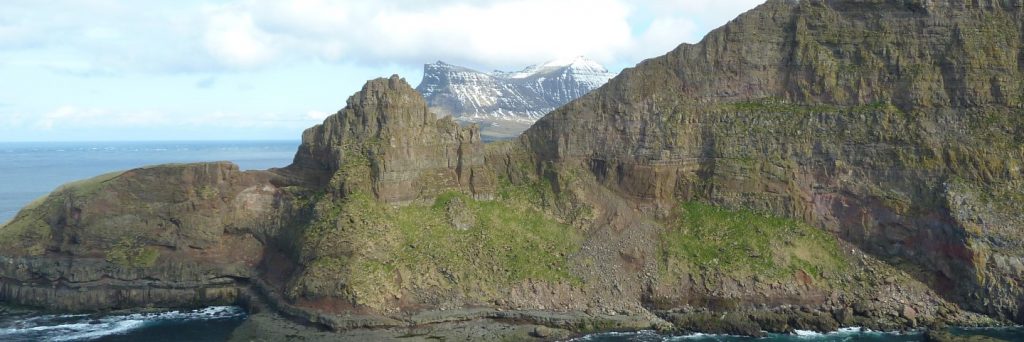
The Faroe-Shetland Basin is highly prospective with proven discoveries ranging from fractured basement to Eocene fans. The primary targets are Paleocene in age and include both sub- and intra-volcanic reservoirs. Late Cretaceous and Paleocene sediments deposited on the western margin of the rift are superbly exposed in the Kangerlussuaq region of southern East Greenland, which lay adjacent to the Faroe-Shetland Basin prior to the onset of seafloor spreading. This region therefore provides sedimentological, stratigraphic and structural controls for the evolution of adjacent basinal areas; it also offers a potential sediment source into these basins. A major consideration when exploring in this region is the impact of volcanism on the hydrocarbon system, from the disruption of sediment pathways to the effect on reservoir quality. The Greenland-Norway Project and the Flood Basalt Impact on Hydrocarbon Systems Project both provide important contributions to exploration models in this challenging region.
Map of Region
Active Research Projects
Most Recent Reports
- The impact of shield volcanism on the syn-volcanic development of a volcano-sedimentary basin: a case-study from the Ethiopian Flood Basalt Province
- Controls on the magnetic susceptibilities of volcanic lithologies
- Secondary mineralisation of volcaniclastic rocks and its impact on sealing capacity and reservoir potential
- Photogrammetric study of the volcanic cliff sections of western Suðuroy, Faroe Islands and their implications for hydrocarbon exploration
- Mercury injection capillary pressure and sealing capacity of mafic volcaniclastic units