
West Siberian Basin
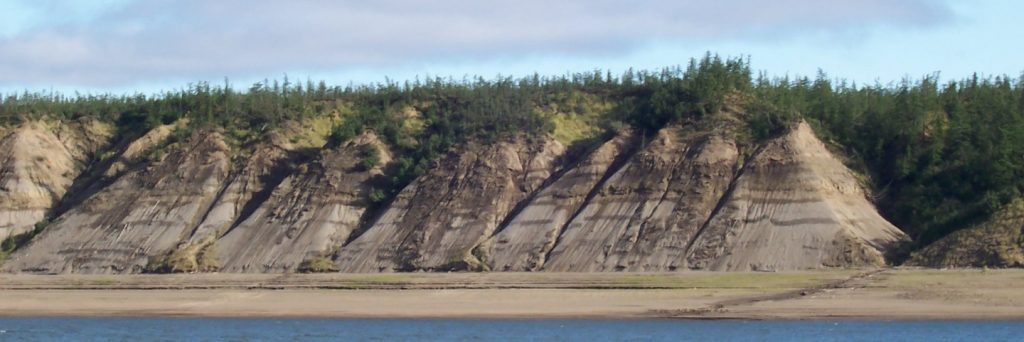
The immense West Siberian Basin accounts for the vast majority of hydrocarbon production in Russia. Although much of the basin is mature with respect to hydrocarbon exploration, large parts of it are underexplored. It formed as a rift basin in the Late Permian to Early Triassic, synchronous with the waning stages of Uralian orogenesis, between the East European and Siberian cratons. The irregular nature of the basement resulted in focused sediment deposition during syn-rift and early post-rift phases. Many fundamental questions remain about aspects of the basin evolution and of reservoir formation, distribution and quality. Exposures of Mesozoic strata occur around the basin allowing sedimentological and structural field investigations as well as enabling sample collection for laboratory analysis.
Map of Region
Most Recent Reports
- Thermal maturity and source rock potential of Late Palaeozoic mudstones, Kara Basin, Nenets Autonomous Okrug, Russia
- Origin of the Vorkuta lava flow and geological implications for crustal thermal evolution of the Korotaikha Basin
- The Ellesmerian orogenic event (Late Devonian to Early Carboniferous) in Russia: evidence and significance. Part 2: Siberia to Chukotka
- Provenance study and zircon analysis for the Jurassic-Cretaceous strata of the Yenisey-Khatanga region
- West Siberian Basin project: Final phase I and II GIS release