
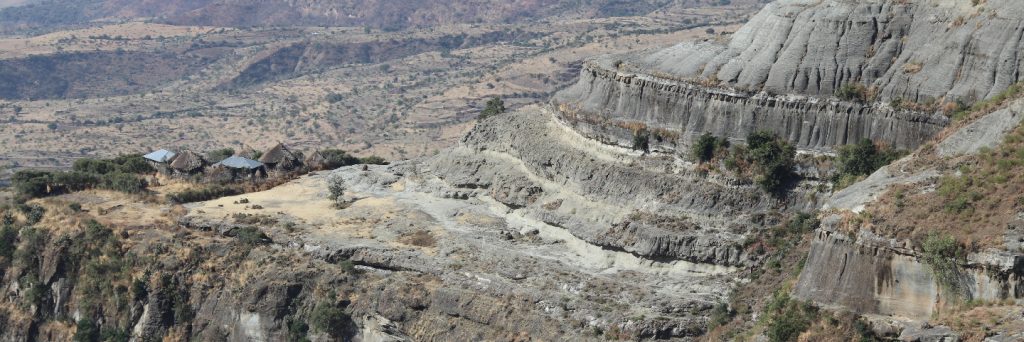
Flood Basalt Impact on Hydrocarbon Systems Project 2019-2021
This project phase comprised seven integrated reports (#18–24) that collectively examined the timing, geochemistry, sedimentary response and diagenetic evolution of flood basalt systems in Ethiopia. As in previous phases, the Blue Nile Basin remained the principal analogue; however, this phase broadened the regional framework to include the Somali Plateau and the Ogaden and Yayu basins, with selected comparative datasets placing the Ethiopian results in a broader volcanically affected basin context.
The phase began with a quantitative assessment of the magnetic properties of volcanic lithologies from the Ethiopian Flood Basalt Province (#18). By integrating magnetic susceptibility measurements with petrographic and geochemical datasets, this study established the controls on magnetic response within volcanic successions and demonstrated how magnetic data can assist stratigraphic correlation, fracture assessment and volcaniclastic identification in subsurface studies.
A complementary regional perspective was provided by detailed stratigraphic, geochronological and geochemical investigation of the Trap Series on the Somali Plateau (#19). This work refined the timing and spatial distribution of Oligocene–Miocene volcanism on the southeast margin of the Main Ethiopian Rift and highlighted fundamental differences in volcanic architecture and intra-volcanic sediment development compared to the Blue Nile Basin. The results provided new insight into basin compartmentalisation and drainage reorganisation during flood basalt emplacement.
The influence of alkaline shield volcanism on syn-volcanic sedimentary systems was explored through a detailed case study of the Selale volcano (#20). Ar–Ar geochronology, geochemistry and field analysis constrained eruption timing, uplift, flank collapse and sediment routing, illustrating how shield edifices can generate uplift plays, reorganise drainage networks and influence burial histories within adjacent basins.
Two further reports focussed on provenance and uplift-related sedimentation. Detrital zircon U–Pb geochronology of sub- and intra-volcanic sandstones (#21) refined source-to-sink relationships and constrained the timing of volcanic debris delivery to regional drainage systems, with implications for the Egyptian Nile system. A multi-proxy provenance study of sub- and intra-volcanic sandstones from the Ogaden and Yayu basins (#22) integrated petrography, heavy mineral assemblages and single-grain chemistry to identify uplift play sandstones and assess the impact of volcanism on sediment routing across adjacent basins.
Diagenetic modification of volcaniclastic-rich successions was explored using a combination of scanning electron microscopy with energy dispersive X-ray spectroscopy (SEM–EDS) and quantitative X-ray diffraction (QXRD) analysis in the following report (#23). Building on earlier project phases that integrated optical petrography, QXRD and Mercury Injection Capillary Pressure (MICP) datasets, this study incorporated high-resolution SEM–EDS analysis to resolve paragenetic sequences and authigenic mineral relationships not previously identifiable. Comparative datasets from East Greenland, the Faroe Islands and Ethiopia demonstrated how site-specific diagenetic pathways affect reservoir quality, sealing capacity and the potential for geological carbon storage in volcaniclastic-rich systems.
The phase culminated in a basin-wide synthesis of the Blue Nile Basin (#24), presenting the first high-resolution sedimentological logging of the Blue Nile Formation, integrated with geochemistry, geochronology and provenance data. This synthesis reconstructed the development of syn-volcanic sedimentary systems during flood basalt emplacement and introduced a process–play framework that showed how palaeotopographic inheritance, volcanic style, drainage reorganisation and volcaniclastic alteration interact to generate heterogeneous reservoir–seal architectures in volcanically affected basins.
Collectively, reports 18–24 provide an integrated, multi-scale framework for understanding the geological evolution and exploration implications of flood basalt provinces. The datasets and interpretations presented in this phase offers valuable analogues for subsurface energy systems and emerging geological carbon storage projects in volcanically affected basins worldwide.
Completed: April 2026.
Contact(s): Simon Passey
Reports Issued in This Project
- Development of syn-volcanic sedimentary systems: A Blue Nile Basin case study
- Elucidating the effects of volcanic debris on sandstone diagenesis, reservoir quality and sealing capacity using scanning electron microscopy
- Multi-proxy provenance study of sub- and intra- volcanic sandstones of the Ogaden and Yayu basins, Ethiopia: Implications for the impact of volcanism on the development of syn-volcanic sedimentary systems
- U–Pb geochronology of zircons from sub- and intra-volcanic sedimentary units, Ethiopian Flood Basalt Province: Implications for the impact of volcanism on the development of syn-volcanic sedimentary systems
- The impact of shield volcanism on the syn-volcanic development of a volcano-sedimentary basin: a case-study from the Ethiopian Flood Basalt Province
- Characterising the Ethiopian Flood Basalt Province on the Somali Plateau, SE Ethiopia
- Controls on the magnetic susceptibilities of volcanic lithologies