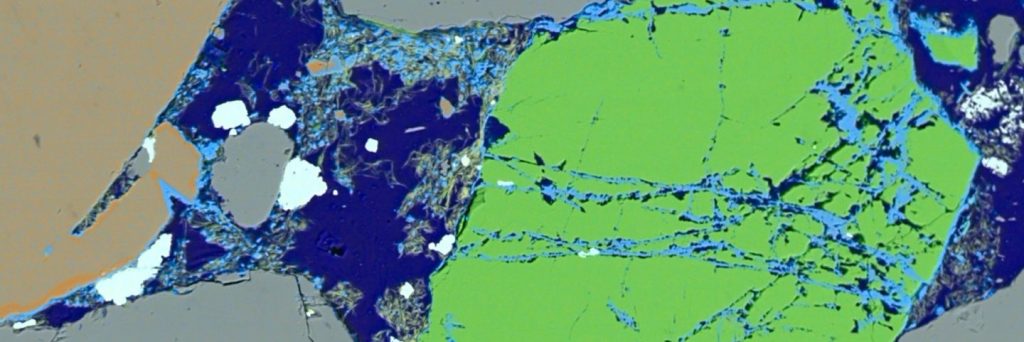
Featured publication: Feldspar reactivity for CCS showcased by experimental and SEM data
CASP researchers, Michael Flowerdew and Michael Pointon, contributed to a newly published article in Solid Earth entitled “Feldspar alteration by disequilibrium CO₂–H₂O fluids in reservoir sandstones: implications for CCS.”. The study has been selected as an EGU Highlight Article , recognising that the reported experimental results contrast with many models on feldspar reactivity in carbon capture and storage CCS projects.
CASP’s involvement arose from Michael Flowerdew’s role as a co-investigator on a research grant awarded to principal investigator Natalie Farrell based at the University of Manchester by the Industrial Decarbonisation Research and Innovation Centre (IDRIC).
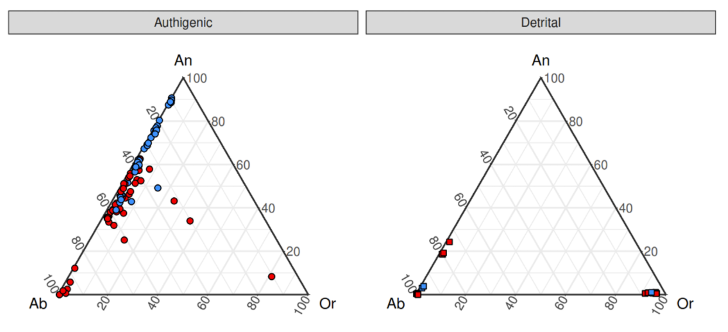
The paper reports experimental results conducted on the Captain Sandstone, the reservoir proposed for the subsurface storage of CO2 as part of the Acorn Project. The experiments were performed under a range of stresses and temperatures that include those that replicate subsurface storage conditions and are illustrated by a series of pre- and post-experimental Scanning Electron Microscopy (SEM) images. These data indicate that feldspars in the sandstone reservoirs can undergo significant chemical and mechanical changes when exposed to CO2 enriched fluids. These findings provide important insights into how reservoir rocks may evolve during long-term carbon capture and storage, helping to improve reservoir performance and security evaluations.
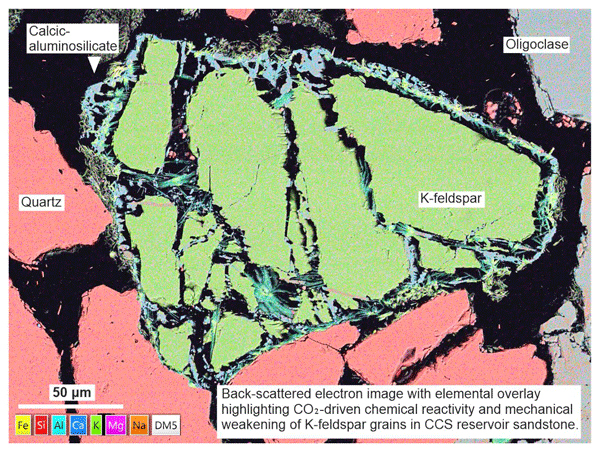
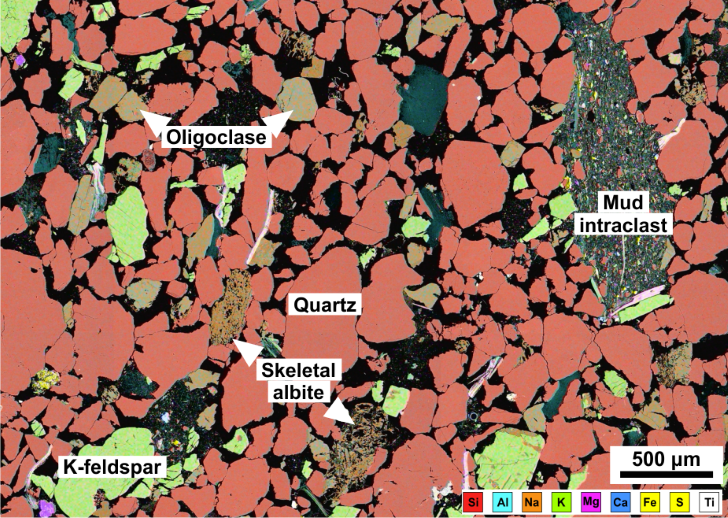
The research has also found that the intricate feldspar textures of the Captain Sandstone were a result of its sediment provenance and diagenetic history, and that this pre-experimental texture influenced the mineralogical and microstructural changes recorded during CO2-enriched fluid experiments under reservoir conditions.
Another outcome of this research comes through the Industrial Decarbonisation Frontiers Report on CO2 Transport and Storage. The report forms one of a series of fourteen reports that bring together the research findings from across the 100 projects funded by IDRIC. Each report makes recommendations to industry and policymakers to support them in attaining their net zero targets.
Data and images collected at CASP’s SEM facility are showcased by this research, and have benefited from acquisition using the Oxford Instruments Unity detector . If your research could benefit from SEM analysis, including the rapid collection of images and data of rough (unpolished) surfaces, please contact CASP.
18 March 2026