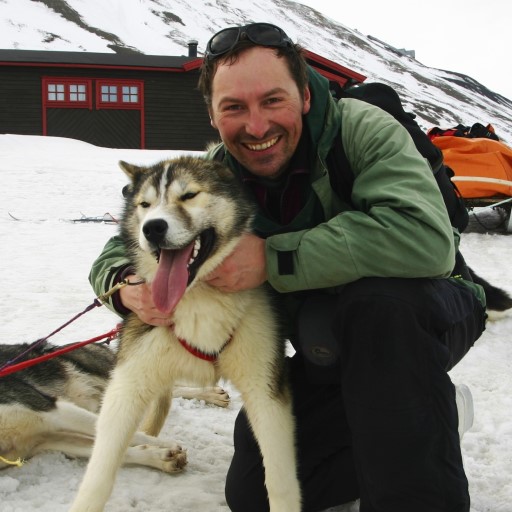
Mike Curtis
Managing Director
Contact: [email protected]
Mike Curtis received his BSc (Hons) in 1989 from the University College of Wales, Aberystwyth, and completed his PhD at the University of Durham in 1993. His doctoral research focused on the Miocene transpressional inversion of the Lusitanian Basin, Portugal, with particular emphasis on the detailed kinematic evolution of fault systems.
Mike joined the British Antarctic Survey in 1993 and subsequently undertook nine Antarctic and sub-Antarctic field seasons, studying a number of Palaeozoic–Mesozoic fold belts as well as dyke emplacement associated with the Karoo plume. In 1997, he participated in a joint UK university–GEUS expedition to southwest Greenland to investigate the Northwestern Border Zone of the Ketilidian Orogen.
Since joining CASP in 2011, Mike has studied the regional tectonic evolution of the Arctic Uralides through structural geological analysis and sediment provenance studies. He has led multiple field campaigns to the remote Nenets Autonomous Okrug, as well as the Polar and Subpolar Urals in Russia. More recently, his research has focused on the influence of subseismic-scale faults on the seal capacity of Lower Jurassic mudstones.
Mike became Managing Director of CASP in 2019 and was awarded the Polar Medal in 2011.
Latest Publications
- The geology of Alexander Island (Antarctic Peninsula): a new 1:500 000 geological map
- Geological map of Alexander Island, Antarctic Peninsula (1:500 000 scale)
- Provenance and correlation of Permian successions from the Falkland/Malvinas Islands with West Gondwana: implications for a Natal Embayment palaeo-location
- Tracking the tempo of a continental margin arc: Insights from a forearc succession in West Antarctica