CASP trustee receives Polar
Medal in New Year Honours
CASP is delighted to report that Prof. John Marshall, Chair of its Board of Trustees, has been awarded The Polar Medal by His Majesty King Charles III in recognition of his outstanding work and contribution to UK scientific knowledge of the polar regions.
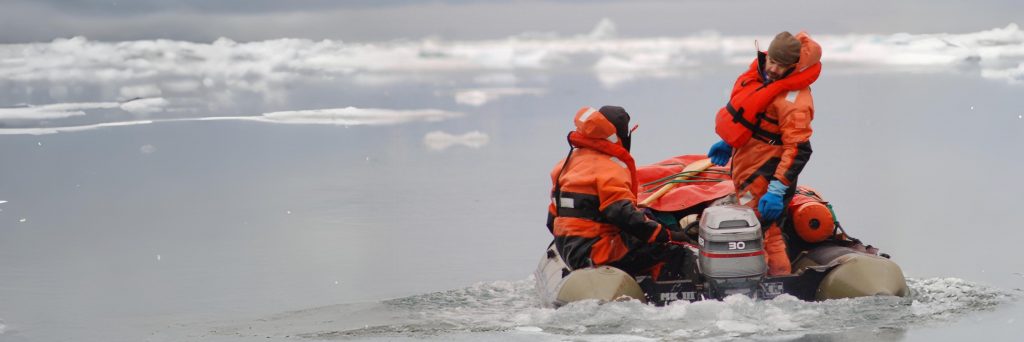
John has undertaken ten expeditions to East Greenland over the past 30 years, logging nearly a year of total field time in remote camps. Access to these sites included travel by inflatable boats, helicopters and light planes capable of landing directly on the Arctic tundra. The majority of these expeditions were conducted in collaboration with CASP.
During these expeditions John has applied his expertise in palynology to both regional and global topics. His discoveries in East Greenland include the earliest known seed plant; resolving the geological ages and environment of the earliest four legged animals; showing that the End Devonian mass extinction (360 Ma) resulted from an ultraviolet ‘burst’ in the Earth’s atmosphere and resolving the debate over the cause of the late Devonian mass extinction (372 million years ago), which he and co-authors demonstrated was due to continental-scale volcanic eruptions.
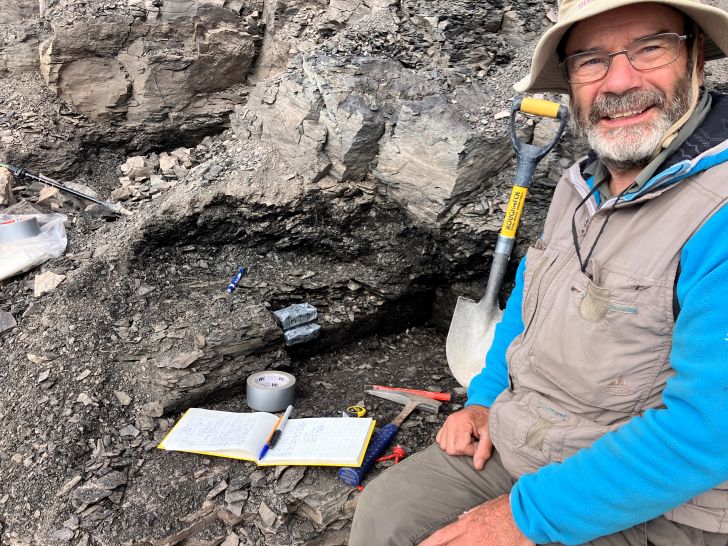
John has also been on nine expeditions to Spitsbergen with discoveries including the identification of a new type of Mid Devonian (384 million years) palaeo-equatorial forest. Study of much younger Spitsbergen strata revealed that a 55 million-year-old palaeoclimatic warming event extended from the paleo-equator into the palaeo-high Arctic.
John become a trustee of CASP in 2007, when the Arctic remained CASP’s principal research focus, helping to provide strategic direction and oversight. During the subsequent eighteen years, he has assumed the roles of Company Secretary and, most recently, Chair.
John said, “it is fantastic to receive this honour and royal recognition for my Arctic research. None of this has been achieved alone as scientific expeditions are always collaborative with many British and international colleagues, and I have benefitted from working with many talented geologists and palaeontologists. It has also always been a pleasure to introduce others to Arctic fieldwork and particularly Geology degree students from Southampton. I have also received the vital support from family at home with ice free conditions in East Greenland always appearing to coincide with school summer holidays. I also particularly value this medal as my great uncle (John Warnock) was awarded one as an officer on the RRS William Scoresby, engaged in Antarctic scientific research, and a predecessor of the NOCS where I am now based. Funding support has been diverse including NERC, CASP, National Geographic Explorers Grants and the ERC. Expedition logistics, particularly in East Greenland, are always complex and I have benefitted from the continued support of CASP in Cambridge.”
9 January 2026